Twenty-five minutes.
That’s what Pomodoro gives you.
Work for twenty-five. Rest for five. Repeat. The most widely recommended productivity system in the world — built into apps, taught in corporate training, written into bestsellers.
It’s also likely working against how your brain actually produces deep work.
Here’s why. And what the research says instead.
The Biological Cycle Your Timer Ignores
In 1969, sleep researcher Nathaniel Kleitman — the man who co-discovered REM sleep — identified a cycle that runs through every waking hour.
The Basic Rest-Activity Cycle. Roughly ninety minutes, all day long.
During sleep, it produces cycling between light sleep, deep sleep, and REM. During waking hours, the same rhythm governs your natural capacity for focused cognitive work.
The first sixty to ninety minutes of a focused session correspond to the peak of this ultradian cycle. Prefrontal cortex running at higher capacity. Working memory more available. The default mode network — the part responsible for mind-wandering — relatively quiet.
After ninety minutes, the trough arrives.
Yawning. Eye heaviness. Difficulty holding a thought. These aren’t failures. They’re biological signals that a cycle has completed and a rest is required.
Most people call this “getting distracted.” The biology doesn’t care what you call it.

The Problem With Twenty-Five Minutes
Pomodoro was designed by Francesco Cirillo as a personal anti-distraction tool. Late 1980s. It works for overcoming procrastination and managing task lists.
It was not designed around cognitive load.
Twenty-five minutes is a shallow entry into deep focus. For complex work — writing, coding, analysis, creative problem-solving — the first fifteen to twenty minutes are typically spent warming up. Retrieving context. Suppressing surface distraction. Building the mental model of the problem.
At twenty-five minutes, you’ve just arrived.
Then the timer ends.
The five-minute break interrupts the neural state you just built. Rebuilding it in the next session takes another fifteen minutes of overhead. Over a four-hour workday using standard Pomodoro, you might accumulate sixty to ninety minutes of actual deep work.
A single uninterrupted ninety-minute block can exceed that entirely.

The Protocol
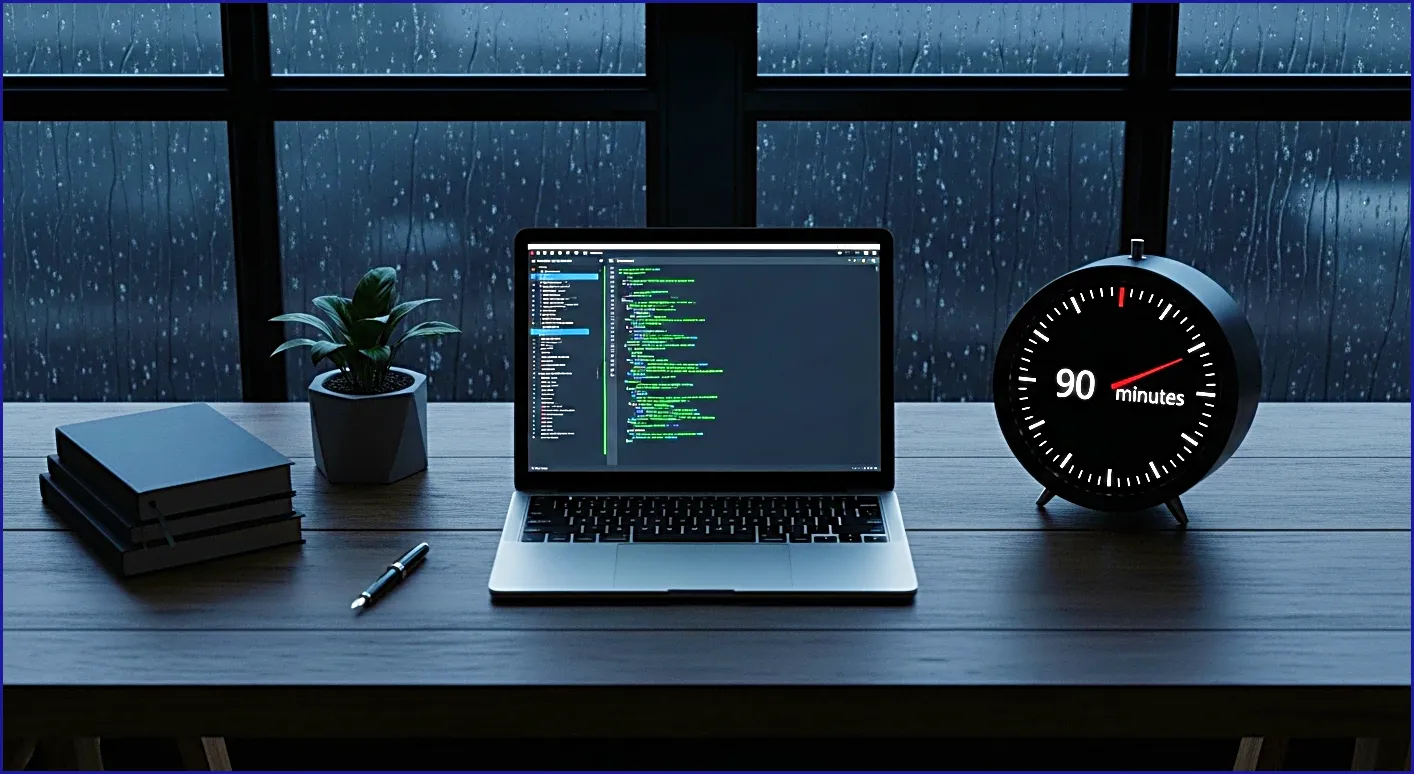
Schedule one to two ninety-minute deep work blocks per day.
Not more. The point isn’t to fill every hour — it’s to protect these windows completely.
During the block: no notifications, no tab-switching, one task. This is also when acoustic anchoring matters most. The transition from scattered attention to deep focus requires an environmental signal — something that tells the brain this time is different.
A consistent sound background serves this function better than silence alone. Particularly in the first twenty minutes, when the warm-up phase is most vulnerable to interruption.
After the block: genuine rest. Twenty to thirty minutes. Not “rest while checking email.” Actual rest — walk outside, lie down, look at nothing. The ultradian trough is not a gap to fill. It’s a recovery requirement.

Why This Feels Harder
Ninety minutes of uninterrupted work is confronting.
No safety valve at the twenty-five-minute mark. No planned excuse to check your phone.
What you encounter instead — in those first sessions — is the actual texture of sustained attention. It’s uncomfortable before it becomes productive. The brain, trained on constant stimulus-switching, rebels.
Most people stop right before deep focus begins.
The Pomodoro timer ends at exactly that moment.
For the acoustic layer of your 90-minute block:
Environmental noise is the single most common reason focus sessions collapse before they deepen. ANC earbuds remove that variable without requiring active management.
Most premium headphones are built for phone calls. Not cognitive isolation. Throwing money at popular brands is a costly illusion. You need a fortress, not just a speaker.
→[Read: The $400 Mistake – Why premium gear might be ruining your focus]
→ Heavy Rain for Deep Focus — CalmSori YouTube
Related FAQ
It matters because a post can look complete while still missing its job. thin content check helps check whether the article actually gives the reader a reason to keep reading.
It should become its own article when the reader has one clear question that cannot be answered well inside another post. Otherwise, it may work better as a section or FAQ.
It should become its own article when the reader has one clear question that cannot be answered well inside another post. Otherwise, it may work better as a section or FAQ.
It should become its own article when the reader has one clear question that cannot be answered well inside another post. Otherwise, it may work better as a section or FAQ.
It should become its own article when the reader has one clear question that cannot be answered well inside another post. Otherwise, it may work better as a section or FAQ.
Before You Go
Paid links- Advertisement -