

When you move one AdSense ad, the next earnings report reflects more than the new position. The site may have had a busier day, a different mix of mobile visitors, or one article that suddenly drew more traffic. A before-and-after check is useful when you decide what to compare before touching the layout.
Start with one placement and one group of pages
Pick a specific change you can reverse, such as moving an existing in-article display ad from below the fourth paragraph to below the second. Record the current rule, the ad unit, the affected URLs or template, and the date you plan to change it. Keep the ad unit, format, and other placements constant during this comparison.
Export a baseline from AdSense for the same site and the affected pages where your reporting supports that scope. Save page views, estimated earnings, Page RPM, and ad impressions. If the report only covers the whole site, label the comparison site-wide so a change on a few pages does not look like a placement-level measurement.
Verify the position on the public site
Open a changed article while logged out on a desktop and a phone. Check the slot relative to the surrounding paragraphs, make sure the other placements are still where you expect them, and inspect an article outside the change to catch an overly broad rule. Let the ad load normally and never click your own live ad during the check.
If cached pages still show the older position, resolve that before starting the comparison. Record the first full day when the new placement is live, and leave the changeover day out of both windows. Check that the slot has room to render without moving a heading or crowding a nearby link.
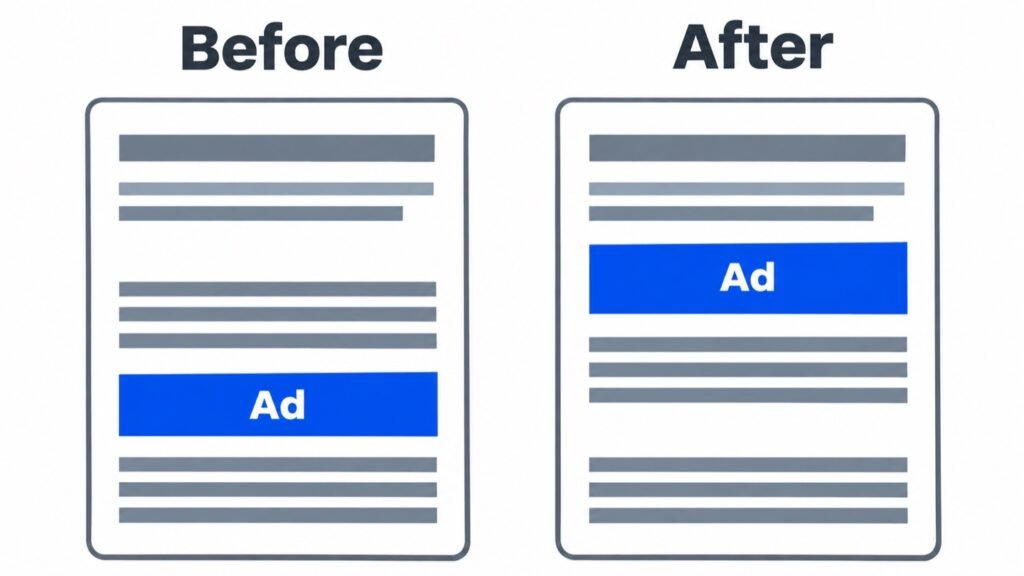
Compare matching weekdays and the same report scope
A practical starting point is one full Monday-through-Sunday period on each side of the change. Use longer matched windows when traffic is sparse, and keep the site, filters, time zone, and currency consistent. If one week includes a promotion or holiday and the other does not, flag it and look for a more comparable window before deciding.
Google defines Page RPM as estimated earnings divided by page views, multiplied by 1,000. In an illustrative example, $12 from 3,000 page views is $4 Page RPM, and $15 from 5,000 page views is $3 Page RPM. Total revenue rose while revenue per thousand page views fell, so the bigger total alone gives you little basis for keeping the new position.
Use the period totals to calculate Page RPM if you export daily rows. Averaging daily RPMs would give a quiet day the same weight as a busy one. Compare estimated earnings and view counts alongside Page RPM, and use ad impressions as an additional clue about what changed.
Decide whether to keep, extend, or reverse the change
Keep the change if the comparison gives you a repeatable reason to do so and the pages still read well on mobile. Extend the test if traffic is thin or the result changes direction across weeks. Reverse the placement if it interrupts reading or causes a layout shift, even if the estimated earnings improved in the first window.
A before-and-after check is observational. Compare the device and country mix where reporting permits, and note any traffic spike or large change in your most-visited pages. For more context, see why AdSense earnings can stay low when traffic rises. For supported Auto ads settings, Google's AdSense Experiments can split traffic between settings at the same time. Check eligibility before treating a manual in-article move as an experiment in that tool.
Related FAQ
Measure it by reader fit, click quality, and whether it strengthens the site path. A high traffic page with weak intent may earn less than a smaller page with clearer decisions.
It can, but only when the topic, traffic, and reader intent match. More monetization options do not help if the visitor has no reason to trust the page.
Measure it by reader fit, click quality, and whether it strengthens the site path. A high traffic page with weak intent may earn less than a smaller page with clearer decisions.
Measure it by reader fit, click quality, and whether it strengthens the site path. A high traffic page with weak intent may earn less than a smaller page with clearer decisions.
Sometimes. Smaller traffic can still matter when the reader has a specific problem and the page leads to a clear next decision.
Before You Go
Paid links- Advertisement -