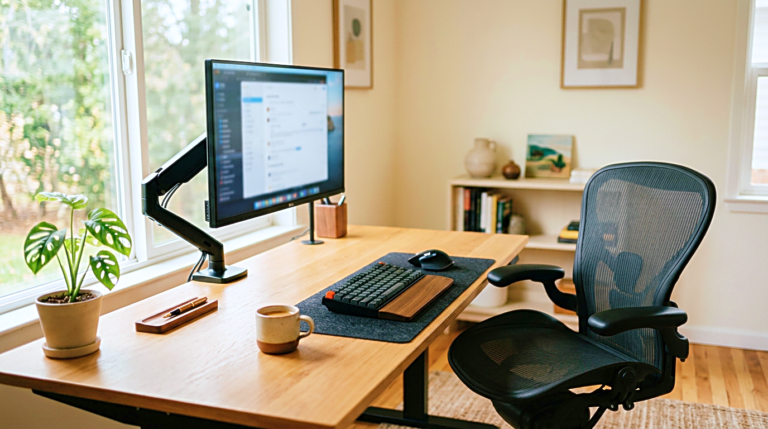
The desk is ready.
The task is open.
Still, the mind keeps moving.
A message. A tab. A small sound from the next room. A thought that has nothing to do with the work.
Focus does not always disappear loudly.
Sometimes it leaks.
Music is not always the answer
Many people use music to focus.
Sometimes it works.
For simple tasks, music can give energy. For cleaning, organizing, or routine work, a playlist may help the body begin.
But deeper work is different.
Reading, writing, coding, studying, planning — these tasks already use language and memory. If the music has lyrics, strong melody, or emotional movement, the brain may start following it.
Not fully.
Just enough.
That small split can matter.
You are working, but part of you is listening.
Rain gives movement without a story
Rain sounds are different.
They move, but they do not speak.
They have texture, but not melody. They fill the room, but do not ask to be followed. That makes them useful for work that needs mental space.
A good focus sound does not entertain you.
It gives your attention fewer sharp edges.
This is where rain can help. It softens the room without becoming another task.
No lyrics. No chorus. No emotional turn.
Just a steady layer behind the work.

Why silence can make focus harder
Silence sounds ideal.
But for some people, complete silence makes every interruption feel stronger. A keyboard tap. A chair. A notification from another room. A car outside the window.
In a very quiet room, each sound arrives with contrast.
Rain reduces that contrast.
It does not remove distractions completely. It simply makes them less separate. The room feels more consistent. The mind does not have to keep checking every small change.
That is often enough.
Not perfect focus.
Just a better starting point.
A simple rain focus routine
Do not make the routine complicated.
The more choices you add, the easier it becomes to avoid the work.
Choose one rain sound. Choose one task. Choose one timer.
Then begin.
For many people, 15 minutes is a good first window. It is short enough to start when resistance is high. Long enough to feel the task again.
After 15 minutes, you can stop.
Or continue.
The point is not to force a flow state. The point is to make the first return easier.
What kind of rain works best for focus
For focus, the sound should be stable.
Not too sleepy. Not too dramatic. Not too close.
A soft room rain, window rain, or distant rain ambience usually works better than storm sounds. Sharp rain can become irritating. Heavy bass can make the room feel dense. Sudden changes can break the session.
The sound should disappear after a few minutes.
That is the sign.
If you keep noticing it, it may be too loud or too detailed for the work.

Use sound as a boundary
The best part of a focus sound is not the sound itself.
It is the boundary it creates.
When the rain starts, the session starts. When the timer ends, the session ends. Over time, that small ritual teaches the room what kind of attention belongs there.
It is not motivation.
It is structure.
The same sound. The same beginning. The same return.
That can be enough on days when focus does not arrive by itself.
A quieter standard
You do not need the perfect playlist.
You may need fewer decisions.
One steady rain sound. Low volume. One visible task. One short session.
If the work feels less scattered after that, keep it.
If it does not, change the room before blaming yourself.
Ready to try it? Open the CalmSori Focus Room for a built-in timer and ambient sound, or explore more Focus Study guides.
Related FAQ
Check the actual friction first: sound, light, posture, screen distance, or visual clutter. rain sound volume helps only when it solves the part of the workspace that is breaking focus.
Comfort usually decides whether the setup is used consistently. Specs matter, but small room sound should first fit the body, room, and work session.
It belongs before the work becomes complicated. recovery after screen work should make it easier to start, continue, or recover from a session without adding more mental noise.
It belongs before the work becomes complicated. deep work environment should make it easier to start, continue, or recover from a session without adding more mental noise.
It belongs before the work becomes complicated. background noise for work should make it easier to start, continue, or recover from a session without adding more mental noise.
Before You Go
Paid links- Advertisement -