
The draft was open, but the article was not ready.
The title looked fine. The keyword was chosen. The idea felt useful enough to write. I thought the next step was simple. Open the editor, start the first paragraph, and let the article grow from there.
Then the writing started to wander.
The opening went one way. The first heading went another. A good example appeared too early. A checklist section showed up before the problem was clear. The article was moving, but it was not moving in a clean direction.
That is when a blog post outline becomes useful.
Not as a strict template. Not as a way to remove the voice from the writing. A good outline gives the creator a small map before the draft becomes too heavy to fix.
For solo creators, that matters. There is no editor waiting to ask whether the article still matches the title. The outline has to do some of that work before the writing begins.
An outline should make the article smaller first
A blog post outline is not there to make the article bigger.
It should make the article smaller.
That may sound strange, but it is where a useful outline begins. A creator often starts with a broad idea. The keyword has room. The topic can go in many directions. The examples keep expanding. If the outline does not narrow the article early, the draft will try to answer too much.
A smaller article is usually easier to trust.
If the post is about a blog post outline for creators, it does not need to explain every kind of writing structure. It does not need to become a full content strategy guide. It needs to help a creator shape one article before opening the draft.
That boundary makes the writing calmer.
A good outline should not ask, “What else can I add?” too early. It should ask, “What is this article really here to solve?”
The title should become the outline’s first rule
The title is the first rule of the outline.
It tells the article what it promised. If the title says the post is about shaping an article before opening the draft, the outline should stay close to that moment. It should not drift into publishing checklists, keyword tools, analytics, or broad creator advice unless those points directly support the draft planning stage.
This is where many outlines become weak.
The creator writes a title, then builds sections that are related but not focused. Each heading seems useful, but the article begins to feel like several posts placed under one title.
A stronger outline uses the title as a filter.
If a section does not help the reader shape the article before drafting, it probably does not belong. It may be useful later. It may become another post. But it should not be forced into this one.
A blog post outline works best when every section helps the title keep its promise.
That is the standard I would use before writing.
The reader problem should come before the section list
It is easy to start an outline by listing headings.
That is not always the best first move.
Before deciding the sections, the creator needs to understand the reader problem. Why would someone search for this topic? What are they trying to make easier? What part of the writing process feels unclear?
For this article, the reader is probably not looking for a decorative template. They are trying to stop the draft from wandering. They may have ideas, keywords, and titles, but the article still feels hard to begin. They need a simple way to turn the topic into a path.
That problem should guide the outline.
Once the reader problem is clear, the headings become easier to choose. The outline can move from title promise to reader problem, from reader problem to section order, from section order to examples, and from examples to the final takeaway.
The outline should not begin as a list of possible points.
It should begin as a response to one reader hesitation.
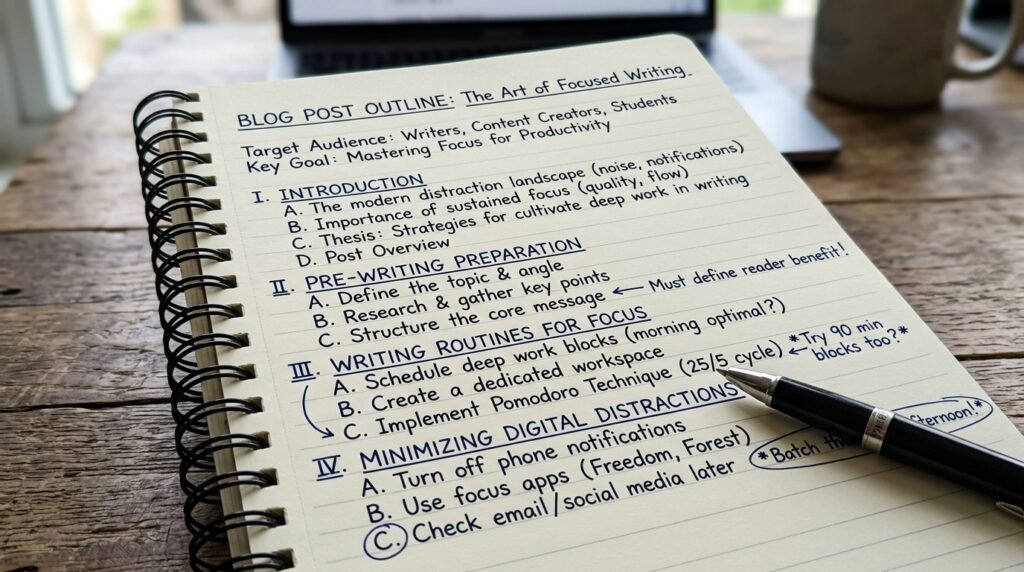
The opening needs a scene before the explanation
A good outline should plan the opening before it plans too many details.
The opening is where the reader decides whether the article understands the moment they are in. If the opening starts too generally, the post can feel distant even when the information is useful.
For a creator article, the opening can be simple. The draft is open, but the article is not ready. The title exists, but the direction is not clean. The writer starts typing, then the sections begin to spread. That scene is close to the real problem.
Once that scene is clear, the explanation has a place to land.
The outline does not need to write the full opening in advance. But it should know what kind of opening the article needs. Is it a failed draft moment? A publishing hesitation? A keyword that looks good but feels unclear? A checklist that keeps getting longer?
That choice matters.
The opening gives the article its first temperature. The outline should not leave it to chance.
The headings should follow the reader’s path
Headings should not be chosen only because they sound useful.
They should follow the reader’s path.
A creator who wants a blog post outline does not need random writing tips. They need to know how to move from idea to draft without losing the article’s shape. The headings should reflect that order.
First, narrow the article. Then use the title as the boundary. Then define the reader problem. Then plan the opening. Then arrange the section order. Then check examples. Then make sure the ending returns to the first problem.
That kind of outline feels calm because the order makes sense.
If the headings can be moved around without changing the article much, the outline may not be strong enough yet. A strong outline has sequence. Each section exists because the previous section made it necessary.
The reader should not feel like they are reading a collection.
They should feel like they are being guided.
Each heading should have one job
A heading becomes weak when it tries to hold too much.
One section may want to talk about the title, search intent, examples, SEO, and final editing all at once. The ideas may be related, but the reader has to work too hard to understand what the section is really doing.
A useful outline gives each heading one job.
One heading explains why the title matters. One heading shows why the reader problem should come before the section list. One heading explains how examples should be chosen. One heading checks whether the ending returns to the opening.
That separation makes the draft easier to write.
It also makes editing easier later. If a paragraph does not support the heading’s job, it becomes easier to move or remove. The writer does not have to judge every sentence by feeling alone. The outline already provides a standard.
A clear heading is not just a label.
It is a small instruction for the draft.
Examples should be planned before the draft gets crowded
Examples often appear while writing.
That can be useful, but it can also make the draft crowded. A creator may add a good example in the wrong place because it feels too valuable to lose. Then another example appears. Soon the article has good material, but the order feels messy.
An outline can prevent that.
Before drafting, it helps to decide what kind of examples belong in the article. For a creator workflow post, examples should come from the actual work: titles, drafts, keyword notes, image directions, headings, publishing steps, and unfinished articles.
Those examples keep the article grounded.
They also help the writer avoid generic advice. Instead of saying that an outline should be clear, the article can show a draft that started with one title and drifted into three different topics. Instead of saying that sections need focus, the article can show one heading trying to do too many jobs.
Examples are not decoration.
They are proof that the article understands the reader’s work.
The outline should leave space for the draft to breathe
An outline should not control every sentence.
If it does, the writing can become stiff. The draft may follow the plan, but it can lose the small discoveries that make the article feel alive. A useful outline gives direction without closing every door.
That balance matters.
The outline should decide the path, the section jobs, and the main standard. But it should leave space for better phrasing, sharper examples, and small adjustments as the article develops. Sometimes the best sentence appears while writing. Sometimes a section needs to move. Sometimes the title becomes clearer after the middle is written.
That does not mean the outline failed.
It means the outline did its job by giving the draft a starting shape.
A good outline is not a cage.
It is a quiet frame.
The ending should be planned before writing too much
The ending is often left for later.
That can make the draft weaker.
If the writer does not know where the article should end, the middle can keep expanding. Every useful point feels like it might belong because there is no clear destination. The article becomes longer, but not necessarily more complete.
A simple ending note can help.
Before drafting, the creator can decide what the reader should take away. For this article, the takeaway is not that every post needs a complicated outline. It is that a small outline can keep the title, reader problem, headings, examples, and conclusion moving in one direction.
That ending note becomes a quiet limit.
It tells the writer when enough has been said. It also helps the conclusion return to the opening. If the opening showed a draft that wandered, the ending should show how an outline makes the next draft easier to begin.
A planned ending makes the whole article easier to finish.

A simple outline can be enough
A blog post outline does not need to be complicated.
For many creator posts, a small outline is enough. The title promise. The reader problem. The opening scene. The main sections. The examples. The criteria sentence. The ending takeaway.
That is already a useful map.
The goal is not to make the writing process look professional from the outside. The goal is to reduce the number of times the creator has to stop and ask, “Where is this article going?”
A simple outline can answer that before the draft opens.
It can keep the post from becoming too wide. It can protect the title’s promise. It can make headings easier to write. It can help examples stay close to the reader’s world. It can give the ending a place to return to.
That is enough.
A creator does not need a perfect plan.
They need a path that is clear enough to start and flexible enough to finish.
A better draft starts before the first sentence
A blog post outline is not separate from the writing.
It is the first quiet part of the writing.
Before the first sentence appears, the outline helps the creator decide what the article is not. It gives the title a boundary, the reader problem a place, the opening a scene, the headings a sequence, and the ending a direction.
That makes the draft less noisy.
The article can still change. The writer can still discover better ideas. The voice can still feel natural. But the draft does not have to carry every decision at once.
For solo creators, that is the real value.
A good outline does not make the article perfect.
It makes the article easier to begin, easier to return to, and easier to finish without losing the reader’s path.
Related FAQ
It matters because a post can look complete while still missing its job. blog post outline helps check whether the article actually gives the reader a reason to keep reading.
It should become its own article when the reader has one clear question that cannot be answered well inside another post. Otherwise, it may work better as a section or FAQ.
It should become its own article when the reader has one clear question that cannot be answered well inside another post. Otherwise, it may work better as a section or FAQ.
It should become its own article when the reader has one clear question that cannot be answered well inside another post. Otherwise, it may work better as a section or FAQ.
It should become its own article when the reader has one clear question that cannot be answered well inside another post. Otherwise, it may work better as a section or FAQ.
Before You Go
Paid links- Advertisement -