
The idea looked ready.
The keyword was chosen. The search intent felt clear enough. The title had a direction. It looked like the article only needed to be written.
Then the draft started to spread.
The opening had one point. The first heading had another. A useful example appeared in the middle, but it pulled the article sideways. Another section felt interesting, but it did not quite belong. The post was getting longer, but not cleaner.
That is when blog post structure starts to matter.
For creators, structure is not only about making an article look organized. It is about helping the reader move from the first question to one useful standard without getting lost along the way.
A good structure does not make the writing stiff. It gives the writing a path.
A blog post needs a path before it needs more sections
More sections can make a post look complete.
They can also make it feel scattered.
A creator may add another heading because the article feels short. Then another example. Then another small explanation. Each part may be useful by itself, but the article can still feel unclear if the parts do not move in one direction.
That is the difference between structure and length.
Length adds more words. Structure gives those words a job. The reader should not feel like they are walking through separate thoughts. They should feel that each section takes them one step closer to the answer they came for.
Before adding more sections, it helps to ask one question.
What path should the reader follow?
If that path is unclear, the article does not need another section yet. It needs a clearer order.
The title decides the first boundary
A blog post structure begins with the title.
The title is not only a place for the main keyword. It is the first boundary of the article. It tells the writer what the post should cover, and just as importantly, what it should not cover.
If the title says the post is about blog post structure for creators, the article should stay close to creator writing, drafts, headings, publishing, and reader flow. It does not need to become a broad writing theory lesson. It does not need to explain every type of blog content. It needs to help a creator shape a post more clearly.
This boundary protects the draft.
Without it, the article keeps expanding. A paragraph about headings can turn into a paragraph about SEO. A paragraph about SEO can turn into keyword research. A section about examples can become a general lesson about content strategy.
All of those may be useful.
But they may belong in another post.
A strong blog post structure begins when the title creates a clear boundary for what the article will and will not cover.
That boundary makes the rest of the writing easier.
The opening should show the problem before explaining it
The opening should not rush into instruction.
A reader needs to feel why the article matters before the article starts teaching. For a creator, that usually means showing a familiar moment: the draft is growing, the headings are multiplying, and the article still does not feel clean.
That kind of opening works because it begins with the reader’s problem, not the writer’s explanation.
A weak opening may define blog post structure too early. It may say that structure is important for readability and SEO. That is true, but it does not pull the reader in. The reader probably already knows structure matters. They need help with the moment when a real draft starts to lose shape.
The opening should make that moment visible.
Once the reader recognizes the problem, the explanation that follows becomes easier to accept. The post is no longer giving abstract advice. It is responding to something the reader has likely felt.
A good opening does not have to be dramatic.
It only has to be close to the work.
The first section should narrow the article
The first section should make the post smaller.
That may sound strange, but it is important. After the opening, the reader needs to know what this article is really about. If the post stays too wide, every later section has to fight for attention.
A good first section names the central problem.
In this article, the problem is not that creators do not know how to write. It is that their posts can grow without a clear path. The draft may have useful parts, but the order does not guide the reader well enough.
Once that problem is clear, the rest of the structure becomes easier.
The title creates the boundary. The opening shows the moment. The first section narrows the problem. The next sections can then move through the parts of the article that shape the reader’s path: title, opening, headings, examples, transitions, ending, and final check.
A post becomes easier to follow when it becomes more specific early.
Headings should move the reader forward
Headings are not just labels.
They are the article’s visible path.
A heading like “Tips” or “Important points” does not do much for the reader. It creates a break, but it does not explain why the next section matters. A better heading tells the reader what the section will change or clarify.
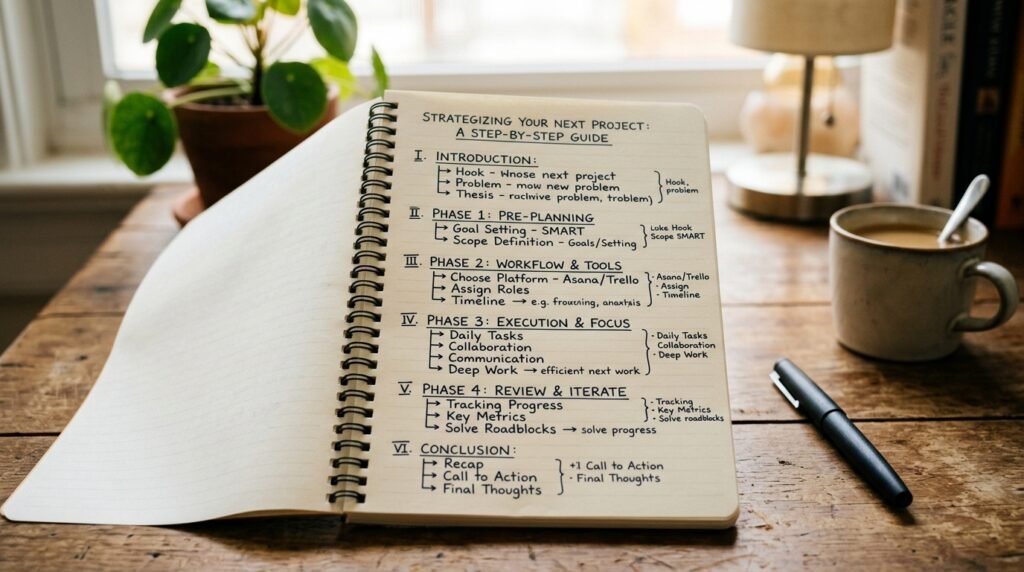
For a creator article, headings should feel like small steps. The title sets the boundary. The opening shows the problem. The first section narrows the article. The examples should match the reader. The ending should return to the first problem.
That order gives the post movement.
It also helps the writer. If the headings do not form a natural path, the article may not be ready for drafting yet. A rough outline can reveal the problem before the full draft becomes heavy.
The best headings do not try to sound clever.
They make the article easier to trust.
Each section should answer one small job
A section becomes weak when it tries to do too much.
One section may explain the topic, give examples, mention SEO, talk about images, and end with a broad reminder. It may contain good sentences, but the reader has to work too hard to understand the point.
A stronger section has one clear job.
The job may be to explain why the title matters. It may be to show how headings guide the reader. It may be to warn against repeating the same point. It may be to explain why the conclusion should return to the opening.
When each section has one job, the article feels calmer.
This does not mean every section has to be short. Some points need space. But the section should not keep changing direction. The reader should be able to understand why the section exists without rereading the heading.
For solo creators, this is also a good editing check.
If a section has two or three jobs, one of them may need its own section, or it may need to be removed.
Examples should come from the same world as the reader
Examples are part of structure.
They decide whether the article feels grounded or generic.
If the post is for creators, the examples should come from creator work: choosing a title, opening a draft, arranging headings, checking images, writing a meta description, preparing a post for publishing, or returning to an unfinished article the next day.
These examples help the reader see the structure in use.
A generic example may explain the concept, but it does not always create recognition. The reader should feel that the article understands the actual workspace, not just the theory.
This matters because structure is easier to understand when it is attached to a real moment.
A creator does not only need to know that a section should have one job. They need to see what happens when a section about headings turns into SEO, content planning, and image selection all at once. That is the kind of drift they can recognize in their own drafts.
Good examples keep the article close to the reader’s desk.
Transitions should explain why the next section exists
A blog post can have good sections and still feel rough.
Often the problem is the transition.
The article moves from title to opening, from opening to headings, from headings to examples, but the reader does not feel why each move is happening. The sections are placed together, but they are not connected enough.
A good transition does not need to be long.
It only needs to show why the next idea follows. If the title sets the promise, the opening needs to confirm it. If the opening shows the problem, the first section needs to narrow it. If the headings create the path, the examples need to prove that the path belongs to the reader’s world.
That quiet logic helps the post feel smoother.
Transitions are especially useful for long articles. They prevent the reader from feeling dropped into a new point without warning. They also help the writer notice when a section is out of place.
If there is no natural transition into a section, the section may not belong there.
The middle should not become a storage space
The middle of the article is where weak structure often hides.
The opening is usually careful because it has to catch the reader. The conclusion is often simple because it closes the post. But the middle can become a storage space for every useful thought that did not fit elsewhere.
That is where the article starts to feel heavy.
A creator may add extra advice because it seems helpful. They may include a related keyword, a side example, or a small explanation that belongs to another topic. The middle grows, but the reader path becomes less clear.
A good middle should deepen the article, not widen it too much.
Each section should still serve the same promise. If the post is about blog post structure, the middle should not drift too far into keyword research, content calendars, analytics, or platform settings. Those topics can support the point briefly, but they should not take over.
The middle should carry the reader forward.
It should not collect everything the writer knows.
The ending should return to the opening
A strong ending closes the loop.
It does not need to introduce a new idea. It does not need to sound inspirational. It does not need to repeat every section in a long summary. It should return to the problem the article opened with and give the reader a clearer way to see it.
If the opening showed a draft that was getting longer but not cleaner, the ending should return to that moment.
The reader should leave knowing what to check next. Is the title still creating the right boundary? Does the opening show the problem? Do the headings move in order? Does each section have one job? Do the examples belong to the reader’s world? Does the middle deepen the article instead of storing extra thoughts?
That is enough.
A conclusion works best when it makes the original problem feel smaller.
The reader should not feel like they have been given another large task. They should feel ready to look at the draft once and see where the path is weak.

A clear structure makes the draft easier to finish
Blog post structure is not there to make writing mechanical.
It is there to reduce drift.
A creator does not need to control every sentence before writing. The draft can still discover things. The article can still change. A better example can appear in the middle. A title can be adjusted after the structure becomes clearer.
But the reader path should stay visible.
The title sets the boundary. The opening shows the problem. The first section narrows the article. The headings move the reader forward. Each section does one job. The examples come from the reader’s world. The middle does not become a storage space. The ending returns to the opening.
That is a structure a creator can use without making the article feel stiff.
The goal is not to make every post perfect.
The goal is to make the reader’s path clear enough that the article can be finished, trusted, and published with less doubt.
Related FAQ
It should become its own article when the reader has one clear question that cannot be answered well inside another post. Otherwise, it may work better as a section or FAQ.
It should become its own article when the reader has one clear question that cannot be answered well inside another post. Otherwise, it may work better as a section or FAQ.
It should become its own article when the reader has one clear question that cannot be answered well inside another post. Otherwise, it may work better as a section or FAQ.
It should become its own article when the reader has one clear question that cannot be answered well inside another post. Otherwise, it may work better as a section or FAQ.
It should become its own article when the reader has one clear question that cannot be answered well inside another post. Otherwise, it may work better as a section or FAQ.
Before You Go
Paid links- Advertisement -