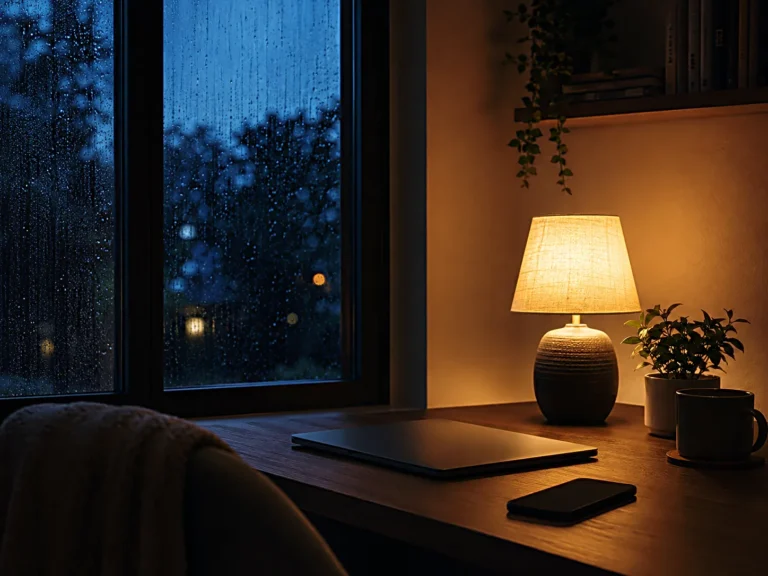
White noise for studying sounds like a small tool.
Turn it on. Open the book. Try to stay with the page.
But the reason people use it is usually not small. Studying breaks easily. A chair moves in another room. A car passes outside. A phone vibrates. Someone speaks for two seconds. The sound disappears, but the attention does not come back as quickly.
That is where white noise can help.
It does not study for you. It does not make the task easier by itself. It simply gives the room a steady background, so small sounds do not feel as sharp.
For studying, that can matter.
Sometimes focus is not broken by one loud noise.
It is broken by too many small ones.
White Noise Can Make Small Sounds Less Noticeable
White noise can help studying because it fills part of the empty background.
A quiet room can feel useful at first. But when the room is too empty, every small sound becomes clearer. A keyboard tap, a hallway sound, a distant voice, a laptop fan, or a car outside can feel larger than it should.
White noise reduces that contrast.
It creates a steady layer behind the task. The sudden sound may still happen, but it does not jump out as much. The room feels less uneven. That can make it easier to return to reading, writing, memorizing, or reviewing notes.
This is the main reason white noise for studying can work.
It is not about making the room silent.
It is about making the room less reactive.
When small sounds stop feeling so separate, the study session can feel easier to stay inside.

White Noise Is Different From Music
White noise and music do not behave the same way.
Music has rhythm, emotion, melody, memory, and sometimes words. That can help with simple tasks, but studying often asks for language and attention. If the song is too interesting, the mind follows it. If the lyrics are clear, the words compete with the page.
White noise is less expressive.
It does not usually have a chorus. It does not change mood in the same way. It does not ask you to follow a melody. For some study sessions, that makes it easier to ignore than music.
This is why white noise can be useful for reading and writing.
The sound gives the room a background without becoming another piece of content. It is not there to motivate you. It is there to make the room steadier.
That is a quieter kind of support.
If music feels too active and silence feels too empty, white noise may sit in the middle.
White Noise Works Best When It Stays Low
White noise can become distracting if it is too loud.
At low volume, it may smooth the room. At high volume, it can feel sharp, close, or tiring. The sound that helped at first can start to press against the task.
For studying, lower is usually better.
The white noise should not cover your thoughts. It should not feel like the main thing in the room. It should sit behind the page, the screen, or the notebook. If you keep noticing it, the volume may be too high.
A simple rule helps.
Start lower than you think you need. Study for five minutes. If small sounds still feel too sharp, raise it slightly. If the white noise itself becomes annoying, lower it or try a softer sound.
The best study sound is often the one you stop noticing.
White noise works when it becomes boring enough to disappear.
White Noise Can Feel Too Sharp for Some People
White noise is not comfortable for everyone.
Some people find it useful. Others find it too bright or too sharp. It can feel like static, air, or a high layer of sound that becomes tiring after a while.
That does not mean white noise is bad.
It means the sound has to match the person and the task.
If you are sensitive to high frequencies, white noise may not be the best study sound. Brown noise may feel deeper. Rain sounds may feel more natural. A fan sound may feel softer. A quiet room may work better for certain kinds of reading.
Focus sounds are personal.
The goal is not to force white noise because it is popular. The goal is to find a background that reduces interruptions without becoming another interruption.
If white noise makes the room feel tense, it is not the right tool for that session.
A study sound should make attention easier to return to.
Rain Sounds and Brown Noise May Feel Softer
Rain sounds and brown noise can be easier than white noise for some people.
Rain sounds feel more natural. They have texture. They can make a room feel less empty without sounding mechanical. That can help when studying alone, especially near a window or at night.
Brown noise feels deeper.
It has less high-end sharpness than white noise. For some people, that makes it calmer during long focus sessions. It can feel more stable and less bright, especially when white noise starts to feel tiring.
But both have tradeoffs.
Rain sounds can become distracting if they include thunder, wind, sudden drops, or dramatic changes. Brown noise can feel too heavy if the volume is high or the session is light. White noise can be useful when the goal is simple masking, but it may feel too sharp for long reading.
The better sound depends on what kind of problem you are solving.
If small sounds keep breaking focus, white noise may help.
If silence feels emotionally empty, rain may feel better.
If sharp sounds feel tiring, brown noise may be easier.
The right choice is the one that creates less friction.
White Noise Helps Most When the Task Has a Clear Shape
White noise cannot fix an unclear study session.
It can smooth the room, but it cannot decide what to study. It cannot choose the chapter, define the question, or make the next step obvious. If the task is vague, the sound may only make procrastination feel calmer.
That is why white noise works best with a clear starting point.
Read five pages. Review one section. Rewrite one note. Solve ten problems. Study for twenty-five minutes. Summarize one lecture. The background sound supports the session, but the session still needs a shape.
Without that shape, any sound can become a distraction.
You keep changing tracks. You keep testing volume. You keep deciding whether rain, brown noise, or white noise feels better. The setup becomes the work.
White noise should not become another thing to manage.
It works best when the task is already small enough to begin.
Headphones and Speakers Change the Effect
White noise feels different through headphones and speakers.
Speakers make it part of the room. The sound sits around the desk. This can feel natural when studying in a quiet bedroom, home office, or library-like space. It also avoids pressure on the ears.
Headphones make it more private.
That can help when other people are nearby, when you do not want to disturb anyone, or when the room has more unpredictable noise. Noise cancelling headphones can also lower part of the outside room before white noise starts.
But headphones can make white noise feel closer.
If the sound is too sharp, headphones may make that sharpness more noticeable. If you use headphones for long sessions, comfort and volume matter more. A low volume through headphones is usually better than a loud background.
The device changes the sound.
A study sound that works through speakers may feel different through headphones. That is why it helps to test both if you use white noise often.
The goal is not the strongest sound.
It is the easiest background.
White Noise Should Not Replace Breaks
White noise can help you stay with a study session.
But it should not turn into a way to ignore fatigue.
If your eyes are tired, the sound will not fix that. If you have been reading for too long, white noise may keep the room steady, but the mind may still need a break. If the task is too long, a focus timer may help more than a different sound.
Studying needs rhythm.
Sound can support that rhythm, but it should not erase it. A short break, a glass of water, a small stretch, or a smaller task can sometimes help more than changing the background noise again.
This matters because focus tools can become a trap.
You keep adjusting the tool instead of noticing that the session needs a pause.
White noise is useful when the room is the problem.
It is less useful when the body is asking for rest.
What to Check Before Using White Noise for Studying
Before using white noise for studying, check the room first.
If the room is already calm, you may not need much volume. If the room has small repeated sounds, white noise may help. If the room has nearby voices, white noise alone may not be enough.
Then check the task.
Reading, writing, memorizing, coding, and reviewing notes do not all need the same background. Tasks with language usually need simpler sounds. Tasks that are repetitive may tolerate richer audio.
Check the sound texture.
If white noise feels sharp, try brown noise. If brown noise feels too heavy, try rain sounds. If rain sounds feel too detailed, return to simpler white noise or lower the volume.
Check the output.
Speakers may feel softer in a quiet room. Headphones may help in a shared space. Noise cancelling headphones may help if background noise is steady, but they are not necessary for every study session.
Finally, check whether the sound disappears.
If you keep thinking about it, it is not background yet.
The Best Study Sound Is the One That Stops Asking for Attention
White noise for studying can help.
But it helps in a quiet way.
It does not make the task exciting. It does not create discipline. It does not replace a clear study plan. It does not work for everyone.
What it can do is make small sounds less sharp. It can give the room a steady layer. It can make silence feel less empty without adding music. It can make attention a little easier to return to after a small interruption.
That is enough for some sessions.
The best study sound is not the one that sounds impressive in the first minute.
It is the one that becomes unimportant.
Low enough to ignore.
Steady enough to stay.
Simple enough to let the page become the main thing again.
Related FAQ
It belongs before the work becomes complicated. white noise for studying should make it easier to start, continue, or recover from a session without adding more mental noise.
It belongs before the work becomes complicated. background noise for work should make it easier to start, continue, or recover from a session without adding more mental noise.
It should earn its space. On a small desk, noise cancelling headphones for focus needs to reduce friction without adding clutter, cable mess, or another maintenance task.
Comfort usually decides whether the setup is used consistently. Specs matter, but small room sound should first fit the body, room, and work session.
white noise machine is worth considering when the current setup creates a repeated problem that cannot be fixed by placement, volume, lighting, or a simpler routine.
Before You Go
Paid links- Advertisement -