Most headphones trap sound entirely inside your skull.
A claustrophobic, two-dimensional echo chamber. You might firmly believe you are focusing, but your brain is actually expending massive amounts of invisible energy. It is constantly trying to decode an unnatural, flattened soundstage that simply does not exist in the physical world.
It feels utterly exhausting.
The Hidden Biological Cost of Silence

The human auditory system was never designed for vacuums.
For millions of years, our survival depended heavily on spatial awareness. When you forcefully jam cheap earbuds into your canals and artificially mute the world, you strip away that evolutionary safety net. Your subconscious immediately goes on high alert. The silence feels heavy. Threatening.
You might not actively notice it while staring at a monitor, but your nervous system is burning through precious glucose. That is the hidden, biological cost of traditional, poorly engineered noise cancellation.
The Spatial Audio Paradigm Shift

True immersion requires physical space.
This is exactly where elite acoustic engineering, like that found in the Sony WH-1000XM6, completely changes the paradigm. It doesn’t just block the world out with a suffocating seal. Instead, it utilizes dual processors and adaptive optimizers to create a vast, three-dimensional acoustic blanket over your environment. Your ears remain safely cocooned, yet the sound feels as wide as an open room.
The Ultimate Focus Geometry

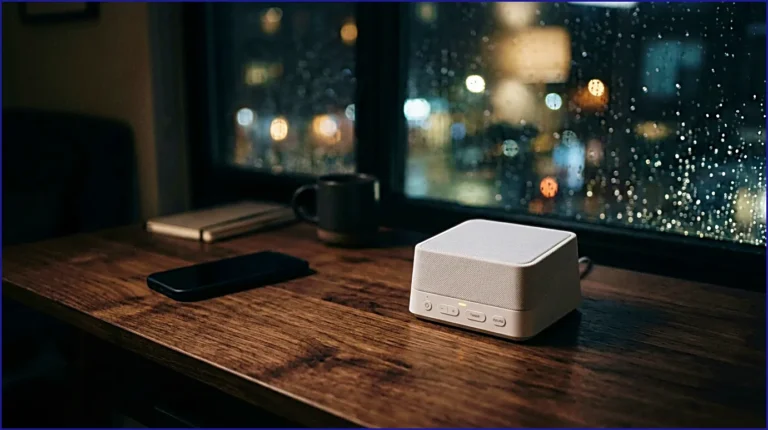
Play our ‘Heavy Rain’ through them.
Notice how the drops don’t just aggressively hit your eardrums. They fall gently around your shoulders, mapping out the true dimensions of the space. Your primitive brain finally stops searching for auditory blind spots.
It relaxes, realizing the environment is completely secure. Stop suffocating your senses. Give them room to breathe.
Explore the Sony WH-1000XM6 Noise Canceling Headphones
Related FAQ
It should earn its space. On a small desk, noise cancelling headphones for focus needs to reduce friction without adding clutter, cable mess, or another maintenance task.
Check the actual friction first: sound, light, posture, screen distance, or visual clutter. rain sound volume helps only when it solves the part of the workspace that is breaking focus.
The quiet mistake is buying for the ideal desk instead of the real room. A useful setup starts with how the space sounds, feels, and behaves during actual work.
Comfort usually decides whether the setup is used consistently. Specs matter, but acoustic environment should first fit the body, room, and work session.
Check the actual friction first: sound, light, posture, screen distance, or visual clutter. rain sounds for studying helps only when it solves the part of the workspace that is breaking focus.
Before You Go
Paid links- Advertisement -