
The keyword looked good.
It had search volume. It matched the site topic. It looked like something people might actually type into Google. The number was clear enough to feel useful, and for a moment, the next article seemed decided.
Then the writing started.
The title felt too broad. The opening did not know who it was speaking to. The examples could go in too many directions. The keyword was there, but the article did not have a clear reader in front of it.
That is when keyword research starts to feel confusing.
For creators, the problem is not always finding keywords. The problem is choosing which keyword deserves the next post. A keyword can have volume and still be wrong for the article. It can look attractive in a tool and still be too wide, too vague, or too far away from the site’s real direction.
Keyword research for creators should not begin with the biggest number.
It should begin with the reader problem behind the search.
Search volume can make a weak topic look stronger
Search volume is useful.
It tells a creator that a topic is not only living inside their own head. Someone is searching for it. Someone has a question, a need, a hesitation, or a problem close enough to type into a search box.
But search volume can also make a weak topic look stronger than it is.
A keyword with a large number may be too broad for a small site. It may attract readers who want something different from what the creator can offer. It may belong to a competitive space where the article needs more authority, more examples, or more depth than the creator can reasonably build in one post.
That does not mean the keyword is useless.
It means the number is only one signal.
A creator still has to ask whether the keyword can become a focused article. Can it turn into a clear title? Can it support a useful opening? Can the post answer one reader problem without becoming too wide? If not, the keyword may need to wait.
A good keyword should not only look good in a spreadsheet.
It should make the next article easier to shape.
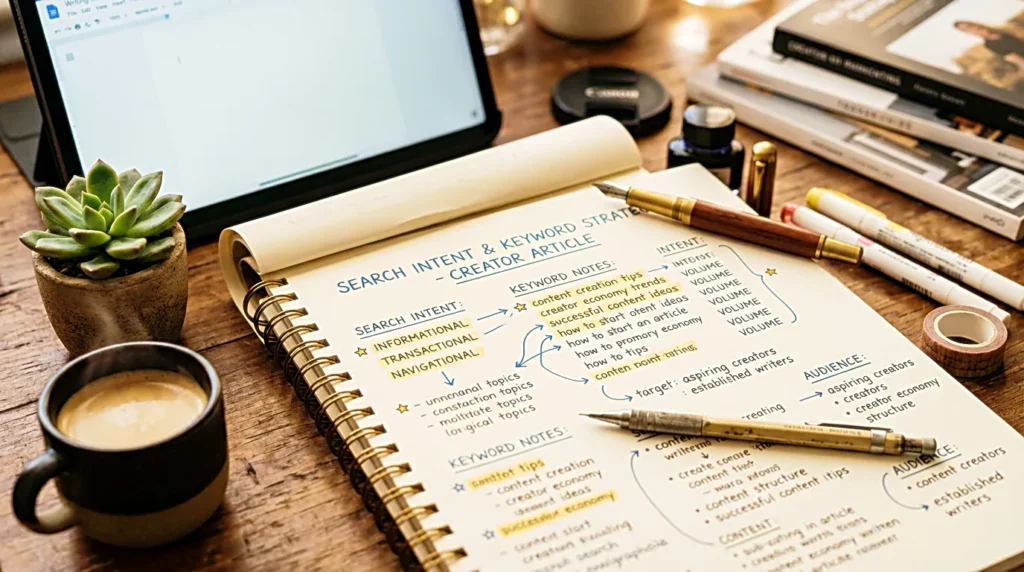
The reader problem should come before the keyword
A keyword is usually a compressed version of a problem.
Someone does not search because they love keywords. They search because they want to fix, choose, understand, compare, start, stop, or decide something. The keyword is only the surface. The reader problem is the reason behind it.
For example, a creator may see a keyword like “content calendar.” That keyword is broad. The reader could be looking for a template, a tool, an example, a strategy, or a way to stop feeling behind. If the article does not choose one of those problems, it becomes vague.
A stronger version starts with the hidden question.
What is the reader trying to solve right now?
Maybe they are not trying to build a perfect calendar. Maybe they are trying to decide what to write next. That changes the article. It changes the title, the opening, the headings, and the examples.
Keyword research for creators works better when the keyword is chosen after the reader problem is clear.
That is the standard I would keep.
A smaller keyword can make a better article
A smaller keyword is not always a weaker keyword.
Sometimes it is the better starting point.
Large keywords can bring possibility, but they also bring looseness. They often require a broad guide, stronger site authority, and more supporting content. Smaller keywords can be closer to a real publishing moment. They can help the creator write a post that feels specific, useful, and easier to finish.
A keyword like “SEO” is too wide for one article on a small creator site. A keyword like “SEO checklist for blog posts” gives the post a clearer job. A keyword like “content creation” is too open. A keyword like “content creation workflow for solo creators” gives the reader and the writer a more defined path.
Specific keywords can also make the article feel more honest.
The creator is not pretending to answer everything. The post is answering one part of the problem well enough to be useful.
That is often how a small site begins to build trust.
Not by chasing the largest keyword first, but by creating clear posts around real reader moments.
The title test shows whether the keyword is ready
Before writing the article, the keyword should pass a title test.
This is simple. Try turning the keyword into a title that feels natural, specific, and useful. If every title sounds vague, forced, or too broad, the keyword may not be ready yet.
A keyword can look good in data and still fail as a title.
That matters because the title is where the keyword becomes a promise. If the promise is unclear, the post will struggle. The introduction may become too general. The headings may not know what to check. The conclusion may end with a broad summary instead of a useful standard.
A good title does not need to be clever.
It needs to tell the right reader why the post exists. It should include the main keyword naturally, but it should also add the situation, the hesitation, or the standard the article will use.
For a creator, this is one of the fastest ways to filter keywords.
If the keyword cannot become a title you would actually publish, it probably should not become the next article.
Search intent decides the article shape
The same keyword can lead to different article shapes.
Some search intents want a checklist. Some want a comparison. Some want a beginner explanation. Some want examples. Some want a tool recommendation. Some want a quiet standard before making a decision.
This is why keyword research is not only a data task.
It is an editorial task.
A creator has to decide what shape the article should take. If the keyword suggests a practical task, a checklist may work better than a long essay. If the keyword suggests confusion, a guide may help. If the keyword suggests comparison, the article may need criteria before options. If the keyword suggests buying, the post should focus on selection standards rather than pressure.
When search intent and article shape do not match, the post feels strange.
The keyword may be correct, but the reader does not get the format they expected. That is why a creator should not only ask, “What keyword should I use?” The better question is, “What kind of article does this keyword want?”
That question makes the writing path clearer.
The keyword should fit the site’s direction
A keyword can be popular and still be wrong for the site.
This is one of the hardest parts of keyword research. A creator may find a strong keyword that looks tempting, but it belongs to a different world. It may not connect to the site’s existing topics. It may not support future articles. It may not help the reader understand what the site is about.
That kind of keyword can create short term interest and long term confusion.
A creator site needs shape. If the site is building around AI tools, workflow, publishing, content systems, and focus, the next keyword should probably live near those areas. It can expand the site, but it should not pull the site into a completely different direction.
This does not mean every post has to be narrow.
It means the keyword should have a reason to belong.
Before choosing a keyword, I like to ask whether it can connect to at least a few future posts. If it stands alone too much, it may not be the right next move, even if the number looks good.
A keyword should help the site grow in a direction.
Not just fill one empty slot.
Related keywords should support the article, not control it
Related keywords can be helpful.
They show how people talk around the topic. They reveal nearby questions, alternative phrases, and smaller angles the article can include naturally. They can also help the writer avoid using the same phrase too often.
But related keywords can easily take over.
A creator may try to include every useful phrase and end up with an article that feels crowded. The post starts answering too many small searches at once. The title says one thing, the middle expands into five related topics, and the conclusion no longer feels focused.
That is not good keyword use.
A better approach is to choose one main keyword, two or three supporting phrases, and a few natural related terms that fit the article’s flow. The related keywords should help the reader understand the topic more clearly. They should not force new sections that do not belong.
SEO should make the article easier to understand.
If a related keyword pulls the post away from the main promise, it belongs in another article.
The competition should change the angle
Competition does not only decide whether a keyword is hard.
It should also change the angle.
If the search results are filled with broad guides, a small creator site may not need to write another broad guide. It may need a more specific angle. If the top results are tool lists, the creator might write about how to choose before adding another tool. If the results are generic checklists, the creator might focus on the creator’s actual publishing moment.
This is where a smaller site can still have a voice.
The goal is not to copy the pages already ranking. The goal is to understand what they cover, then find the part of the reader problem that still feels underexplained or too generic.
A good angle often comes from the creator’s own context.
Solo workflow. Limited time. Too many tools. Unfinished drafts. Quiet publishing routines. Search intent that needs a practical standard. These angles can make a familiar keyword feel more specific and useful.
Competition should not make the creator give up immediately.
It should make the article sharper.
The keyword should lead to a finishable draft
A good keyword should not only be searchable.
It should be finishable.
This matters more than it first appears. Some keywords create articles that are too large, too vague, or too demanding for the current stage of the site. The creator opens the draft and quickly realizes the post needs more research, more examples, more authority, or more sections than expected.
That kind of keyword can slow the whole workflow.
A finishable keyword has a clear scope. The creator can explain the problem, build the headings, give practical checks, and close the article without pretending to cover everything. It should feel like a post, not a book.
Before committing to a keyword, it helps to outline the article quickly.
Can I write the title? Can I write the opening scene? Can I name the main problem? Can I create seven to ten useful sections? Can I finish with one clear standard?
If the answer is yes, the keyword is ready enough.
If the answer is no, the keyword may need a narrower angle.

The next keyword should make the next post easier
Keyword research is not only about one post.
It is about the next few posts.
A creator website becomes stronger when articles begin to support each other by topic, language, and reader problem. That does not mean forcing links into every draft. It means choosing keywords that naturally live near each other.
One article about AI productivity tools can support another about creator workflow. A post about creator workflow can support a publishing checklist. A publishing checklist can support a blog post checklist. A blog post checklist can support an SEO checklist. Over time, the site starts to feel less random.
The next keyword should help that shape grow.
If a keyword opens a useful path for future posts, it may be worth choosing even if the volume is not the biggest. If a keyword has volume but leads nowhere else, it may be less useful than it looks.
A good keyword does not only answer today’s search.
It helps build tomorrow’s site.
Keyword research should make writing calmer
Keyword research can easily become another place to hesitate.
There are always more numbers to check. More related keywords to compare. More search results to scan. More tools to open. More possible titles to test.
At some point, the creator has to choose.
The goal is not to find the perfect keyword. The goal is to find a keyword that has search demand, fits the site, matches a real reader problem, and can become a focused article.
That is enough to move forward.
A good keyword does not make the whole article easy, but it does make the path clearer. The title has a promise. The opening has a reader. The headings have direction. The examples have a world to belong to. The conclusion has a standard to return to.
That is the quiet value of keyword research for creators.
It does not begin with the biggest number.
It begins with the problem the reader is trying to solve, and the article the creator can actually finish.
Related FAQ
It can support search traffic when it matches intent, category fit, and a real reader problem. The topic still needs a useful article, not just a keyword placed in the title.
It can support search traffic when it matches intent, category fit, and a real reader problem. The topic still needs a useful article, not just a keyword placed in the title.
It should become its own article when the reader has one clear question that cannot be answered well inside another post. Otherwise, it may work better as a section or FAQ.
Decide the page job first. Google Keyword Planner works best when it supports a clear reader path instead of becoming another checklist with no publishing decision behind it.
It can support search traffic when it matches intent, category fit, and a real reader problem. The topic still needs a useful article, not just a keyword placed in the title.
Before You Go
Paid links- Advertisement -