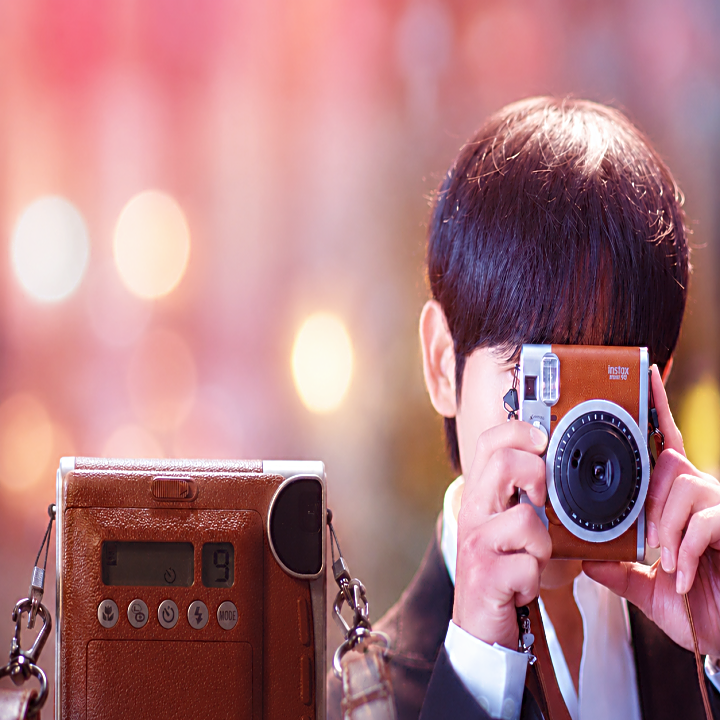
The brown Instax Mini 90 in Our Sticky Love is the camera that catches the eye, but it is no longer the easiest camera to recommend. Fujifilm has discontinued it. Buy a used Mini 90 only if that exact brown body is what you want. Choose the current Instax Mini 99 if every shutter press should become a print, or the Mini Evo if you want to see the photograph before spending film on it.
That is the whole decision in one scene. Go Eun-sae and Jang Tae-ha move into the frame, the shutter closes, and the camera has already committed them to a photograph. No screen offers a safer expression. No delete button returns the sheet of film.
The Mini 99 preserves that small uncertainty. The Mini Evo removes most of it. Both make the same pocket-size Instax Mini print, yet they ask for a different kind of photographer before the first film pack is opened.
The camera in the scene is now a condition purchase
The Mini 90 once made the choice simple. Its brown body looked warmer than a typical instant camera, while macro, landscape, bulb, double exposure, brightness control, and a self-timer left room to shape the shot before pressing the shutter.
Discontinuation changes what you are buying. A listing may describe a camera as tested when the seller has only confirmed that it powers on. That does not tell you whether the flash fires correctly, the rollers move film evenly, the controls respond, or a fresh sheet ejects without hesitation.
An unopened box does not remove every question either. Storage conditions and battery age remain invisible. Once nostalgia lifts the price near a current model, the Mini 90 stops being the obvious route to the scene and becomes a used-camera inspection.
The old camera still has one advantage no successor can copy: it is the brown Mini 90 you remember. If that identity matters more than warranty, parts availability, or an easier return, a carefully tested example may be worth the search. If the photograph-making experience matters more, the current lineup offers two clearer paths.

Decide whether the photograph is chosen before or after the shutter
Specifications make these cameras look closer than they feel. Both use Instax Mini film. Both place a small physical photograph in your hand. The meaningful difference is the moment when film becomes part of the decision.
| Buying question | Instax Mini 99 | Instax Mini Evo |
|---|---|---|
| Can you review the image first? | No | Yes, on the rear LCD |
| Does every shutter press use film? | Yes | No, only selected images are printed |
| Can it print phone photographs? | No | Yes, through the smartphone app |
| Where do creative choices happen? | Before exposure, with analog controls and shooting modes | Before printing, with digital effects and image selection |
| Best fit | Someone who wants the one-shot instant-film experience | Someone who wants fewer wasted prints and more flexibility |
| Main tradeoff | A missed frame still consumes film | Preview and selection soften the analog uncertainty |
This is more useful than asking which camera is better. A person who enjoys waiting for an unrepeatable print may find the Evo too controlled. A person photographing children, pets, or groups may stop carrying the Mini 99 after a few expensive missed frames. The better camera is the one whose mistakes you can live with.
Choose the Mini 99 when the wait is part of the photograph
The Instax Mini 99 is the closer successor to the Mini 90’s analog behavior. There is a small status display for settings, but no rear image-review screen. The shutter exposes Instax Mini film and the sheet ejects. The photograph has already been made before its colors begin to appear.
Its extra controls matter because they all work before that point. Six internal color effects, five brightness levels, a manual vignette switch, bulb and double exposure modes let you shape the result without turning the camera into a digital preview device. Macro, normal, and landscape distances are selected manually with the lens ring, so the camera rewards a little attention before the shot.
That last detail deserves more weight than the effects. The Mini 99 does not quietly solve every distance choice for you. A close subject, a person across the room, and a landscape beyond three meters do not use the same setting. Anyone who wants a simple point-and-print camera may find that deliberate. Someone attracted to the Mini 90 scene may see it as the reason to buy.
Choose the Mini 99 when one printed attempt feels more valuable than ten nearly identical digital frames. It fits portraits made with time, travel photographs composed before the shutter, double exposures, and the pleasure of passing a still-developing print to someone without approving it first.
Choose the Mini Evo when a failed print would stay in the drawer
The Instax Mini Evo starts on the other side of the decision. Its shutter records a digital image, the rear LCD shows the result, and the print lever sends only a selected frame to film. Someone can blink, a pet can turn away, or the framing can fail without using another sheet.
The Evo also works as a small smartphone printer. A photograph already on your phone can move through the app and onto Instax Mini film, which gives the camera a job even on days when the phone took the better picture. Internal storage and microSD support keep more images available for later selection.
Ten lens effects and ten film effects create one hundred combinations, and trying them does not automatically consume a print. That makes the Evo easier to share with family members and more forgiving at parties or on trips, where the person holding the camera may change from one frame to the next.
The tradeoff is not print quality versus convenience. It is the feeling around the shutter. The Evo lets the photograph wait for approval. If that sounds like relief, it is probably the right model. If it sounds too close to choosing from a phone gallery, the Mini 99 will feel more distinct.
One film pack reveals which freedom you actually want
Instax Mini film is sold in limited exposures, so the difference becomes visible quickly. With the Mini 99, every shutter press spends one frame. With the Mini Evo, many digital photographs can be taken while film is reserved for the images chosen to leave the camera.
The Evo protects film from closed eyes, poor timing, and uncertain framing. That can make it the more economical camera for group events, children, pets, and anyone still learning what an instant print will look like.
The Mini 99 offers another kind of economy: fewer casual shutter presses. Knowing that a frame has a cost can slow the hand long enough to notice the background, subject distance, and light. The camera does not save a failed photograph, but it may change how the photograph is made.
Think beyond the first pack. If every imperfect print will feel wasteful, the Evo is more likely to leave the house. If reviewing photographs is the habit you are trying to escape, the Mini 99 gives film a clearer role.
A used Mini 90 should survive one fresh film pack before you trust it
The exact brown camera can still be the right purchase, but the seller’s description should answer more than whether it turns on. Ask whether a fresh pack has passed through the camera and whether the resulting photographs developed evenly.
- Confirm that the flash, mode buttons, brightness control, and self-timer respond.
- Check that film ejects smoothly and the rollers do not leave repeated marks across the print.
- Inspect the battery compartment and confirm that the correct battery and charger are included.
- Look for cracks around the film door, lens barrel, tripod mount, and strap points.
- Compare the full used price with a current Mini 99 after missing accessories and return terms are counted.
A seller unable to test with film is not automatically hiding a fault, but the uncertainty belongs in the price. Nostalgia can justify choosing an older camera. It should not erase the cost of finding another one if the first pack reveals a problem.
Buy the camera you will still carry after the first photographs
Return to the scene in Our Sticky Love. The camera waits on its tripod, two people enter the frame, and the shutter makes the choice final. If that finality is what stayed with you, the Instax Mini 99 is the current camera that keeps it closest.
If what stayed was the small print in their hands, the Mini Evo reaches it with fewer sacrificed frames. You can protect film, print a photograph from your phone, and still pass a physical image across the table before the day is over.
The brown Mini 90 belongs to a third buyer: someone who wants the object as much as the process and accepts the condition check that comes with it. That is not the practical winner, but it can be the honest one.
Choose the Mini 99 when the shutter should decide. Choose the Mini Evo when you should decide after the shutter. Search for the Mini 90 only when the camera from the scene is the photograph you were trying to keep.
Related FAQ
Check the real use case first. phone stand should solve a repeated work, focus, recording, or rest problem before specs or discounts decide the purchase.
Check the real use case first. focus timer device should solve a repeated work, focus, recording, or rest problem before specs or discounts decide the purchase.
Check the real use case first. earbuds for work should solve a repeated work, focus, recording, or rest problem before specs or discounts decide the purchase.
Check the real use case first. best desk speakers should solve a repeated work, focus, recording, or rest problem before specs or discounts decide the purchase.
Check the real use case first. adjustable laptop stand should solve a repeated work, focus, recording, or rest problem before specs or discounts decide the purchase.
Before You Go
Paid links- Advertisement -