A sleep mask fits well when the edge closes around your nose without asking the strap to do all the work. If you have to pull it tight to block a thin line of light, that tension usually reappears at your temples, behind an ear, or against the pillow. The useful fit test therefore starts at the nose and moves outward, long before fabric, color, or the number of layers becomes the deciding feature.
The difference often arrives a few minutes after the room goes dark. The mask feels soft while you are lying on your back, then you turn toward the pillow and a pale line opens beside the nose. One edge shifts toward an eye, and the adjustment buckle that seemed invisible in your hand settles between your temple and the pillowcase.
Nothing dramatic has failed. The mask is simply meeting the face and the bed at the same time, which a product photo cannot show. Follow that small movement through the night and the features that matter begin to arrange themselves in a much clearer order.
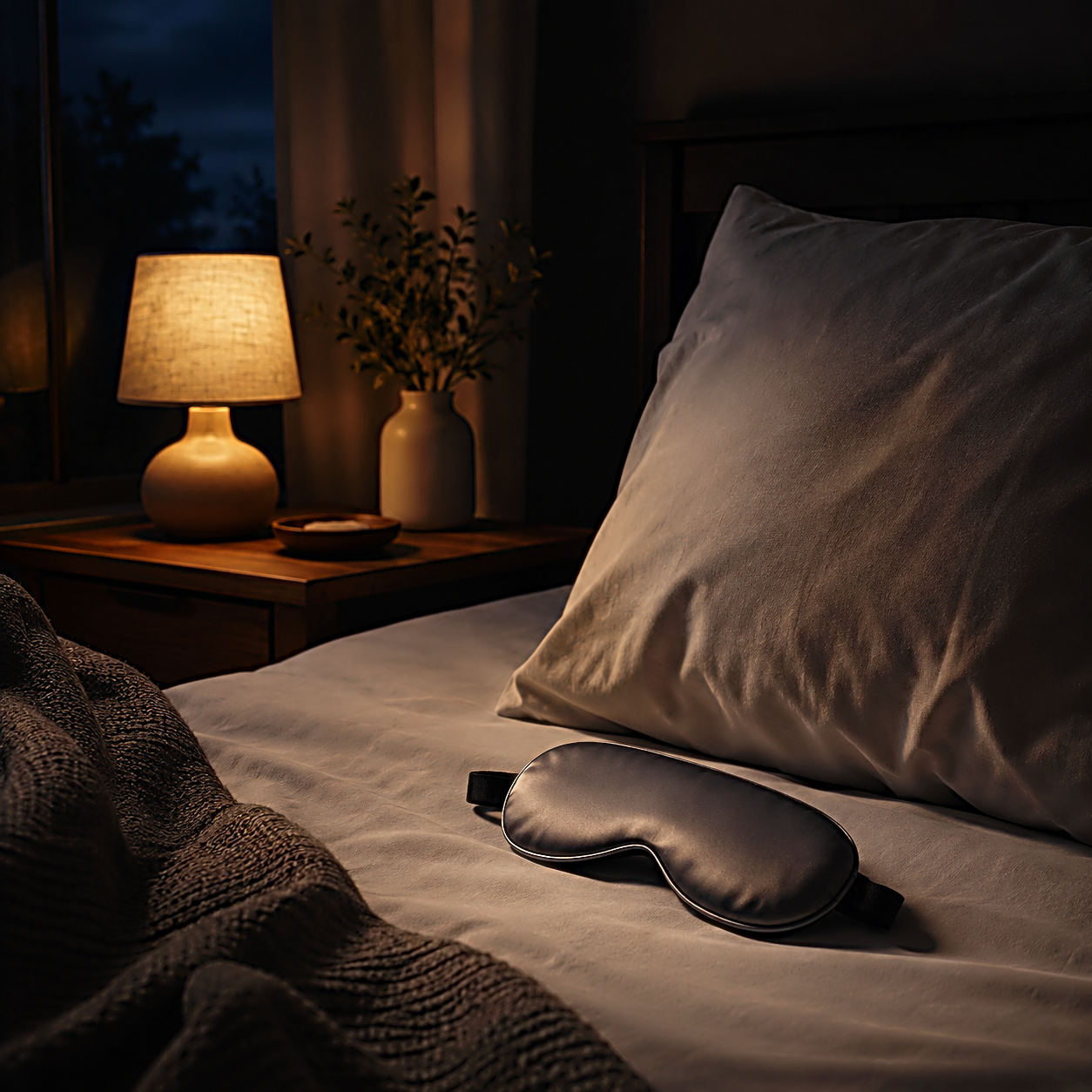
The first line of light usually opens beside the nose
The center of a sleep mask has the easiest job. An opaque panel can cover both eyes, but the lower edge has to follow a bridge, two cheeks, and the shallow curves beside the nose without leaving a gap. A mask that looks wide enough from the front may still stretch across those contours instead of settling into them.
That gap can seem trivial in daylight. In a dark room, a charging light on the dresser or the first morning sun needs only a narrow opening to become noticeable. The question is not whether the mask covers the eye area; it is whether the lower edge stays close to the face after your head changes position.
Nose pieces approach this problem in different ways. A flexible flap can settle into the space beside the bridge, while a deeper cutout may follow a more pronounced nose without lifting the rest of the mask. Flat fabric can work as well when it drapes naturally, but a straight, tense lower edge is more likely to bridge over the face and leave light underneath.
No single contour fits every face. Bridge height, cheek shape, and the distance between the nose and eyes change where the edge lands, so a feature described as “blackout” is still dependent on fit. A more revealing test is whether the gap closes with gentle placement rather than force.
Hold the mask against your face before tightening the strap. If the nose area already sits close and the room becomes dark, the shape is doing its share of the work. When the seal appears only after the band is pulled hard, the missing light has not disappeared for free; its cost has moved toward the sides of your head.
Pulling the strap tighter moves the problem to your temples
A loose mask can slide, so tightening the band feels like the obvious repair. A small adjustment may stabilize the fit, yet increasing tension cannot correct every mismatch in shape. Past a certain point, the strap presses the front panel into the face while concentrating its pull at the temples or behind the ears.
The effect is easy to miss while you are sitting upright. Your attention stays on the darkness, and a firm fit can feel reassuring for the first minute. Once your head rests on a pillow, the same band may feel shorter because the mask, hair, and pillow are all resisting movement in different directions.
Band width changes how that pressure arrives. A narrow elastic strap occupies little space and can be easy to pack, though its tension is carried along a smaller line. A wider band spreads the load across more of the head, but it may feel warmer or interfere with hair depending on where it sits.
Hardware matters for the same reason. A slide buckle can offer precise adjustment, hook-and-loop closures provide a broad range, and fixed elastic removes a hard component entirely. Those differences become useful only after you locate the buckle or seam relative to your usual sleep position.
A stable setting often feels a little looser than expected. The mask should remain in place when you turn without making the eye area feel compressed or leaving a narrow band of pressure around the head. Secure describes a shape that stays with you; tight describes the effort being used to keep it there.
That distinction leads naturally to the pillow. Even a balanced strap can become uncomfortable when the outer edge is pushed inward from one side, and this is where back sleepers and side sleepers begin evaluating the same mask differently.
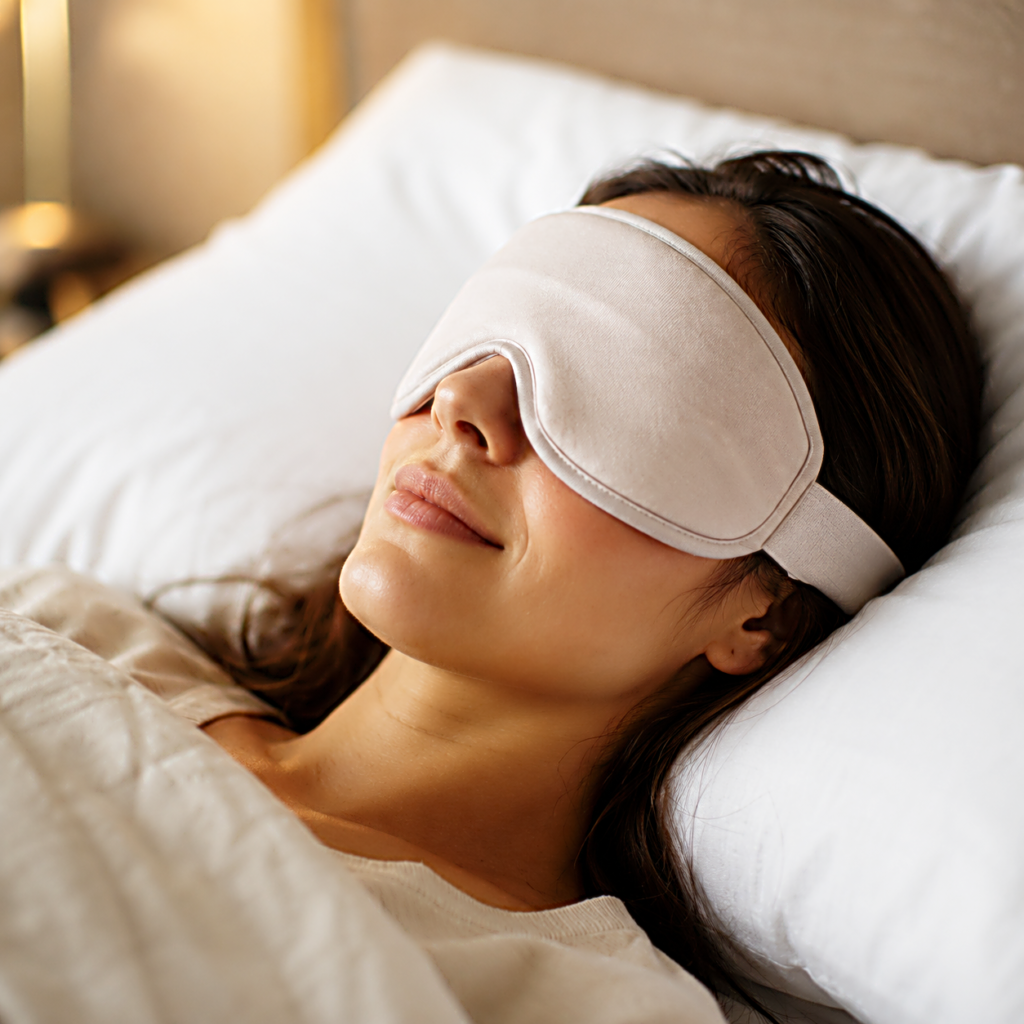
The pillow reveals the edge you could not feel upright
On your back, a sleep mask meets the face almost evenly. Turn onto one side and the pillow presses against a single temple, which can push a thick edge inward or lift the opposite side away from the nose. The mask is no longer resting only on you; it has become part of the surface between your head and the bed.
This is why a sleep mask for side sleepers often uses a lower outer profile. Softer, tapered edges leave less material for the pillow to catch, while adjustment hardware placed away from the temple reduces the chance of a hard spot. A thick molded mask may still work, especially on a soft pillow, but its shape needs room to settle without twisting.
The pillow changes that answer more than most size charts suggest. Soft fill allows part of the mask to sink in, whereas a firmer pillow pushes back directly against the frame and strap. Someone who changes pillows for travel may notice that a familiar mask suddenly feels wider or less stable even though its adjustment has not moved.
Eye cups introduce another tradeoff at this point. A contoured sleep mask can keep fabric away from the eyelids and give eyelashes more clearance, but deep cups also add structure to the front. More space inside can mean more material outside, exactly where the pillow applies pressure during side sleeping.
The useful depth is not the deepest one available. It is enough room to blink or briefly open your eyes without contact, while keeping the outer shell low enough for your sleeping position. If the pillow shifts the cup every time you turn, the eye space has solved one problem by reopening the light seal.
By now the mask has passed the parts of the test that decide whether it stays dark and stable. Only then do surface feel, padding, and weight become meaningful choices. They can refine a shape that already works, but they cannot rescue one that keeps moving around the nose and temples.
Silk, eye cups, and weight matter after the shape works
A silk sleep mask changes the surface against the skin. The material can feel smooth and light, and a flat silk design usually folds into a small travel pouch with little effort. None of those qualities guarantees a close nose seal or a strap that stays in place.
That separation keeps the decision honest. If two masks fit equally well, fabric can become the tie-breaker: one person may prefer a cool, smooth surface while another wants the cushioned feel of foam or soft knit. When one design leaks and the other does not, material should not overrule the basic geometry.
Cleaning belongs in the same layer of the decision. The mask spends hours against skin, hair, and bedding, so care instructions affect whether it remains pleasant to use. Delicate fabric may need hand washing and careful drying, while a removable cover or washable construction can make routine care simpler.
A weighted sleep mask changes more than the fabric. Instead of trying to disappear, it adds a deliberate feeling of pressure across or around the eye area. Some sleepers enjoy that sensation, while others learn quickly that even light contact near the eyes is already more than they want.
Weight distribution matters more than the headline number. Filling that shifts into a narrow area can feel very different from weight spread across a broad surface, and turning onto one side may move that pressure toward a cheek or temple. A weighted design is therefore a separate preference, not an automatic upgrade from a standard blackout sleep mask.
For a first mask, a simpler adjustable design often reveals more. Once you know whether you dislike eyelid contact, need a flexible nose area, sleep mainly on your side, or prefer noticeable pressure, the extra features become targeted choices instead of guesses. That knowledge is most useful when you test the mask for longer than the few seconds allowed by a mirror.
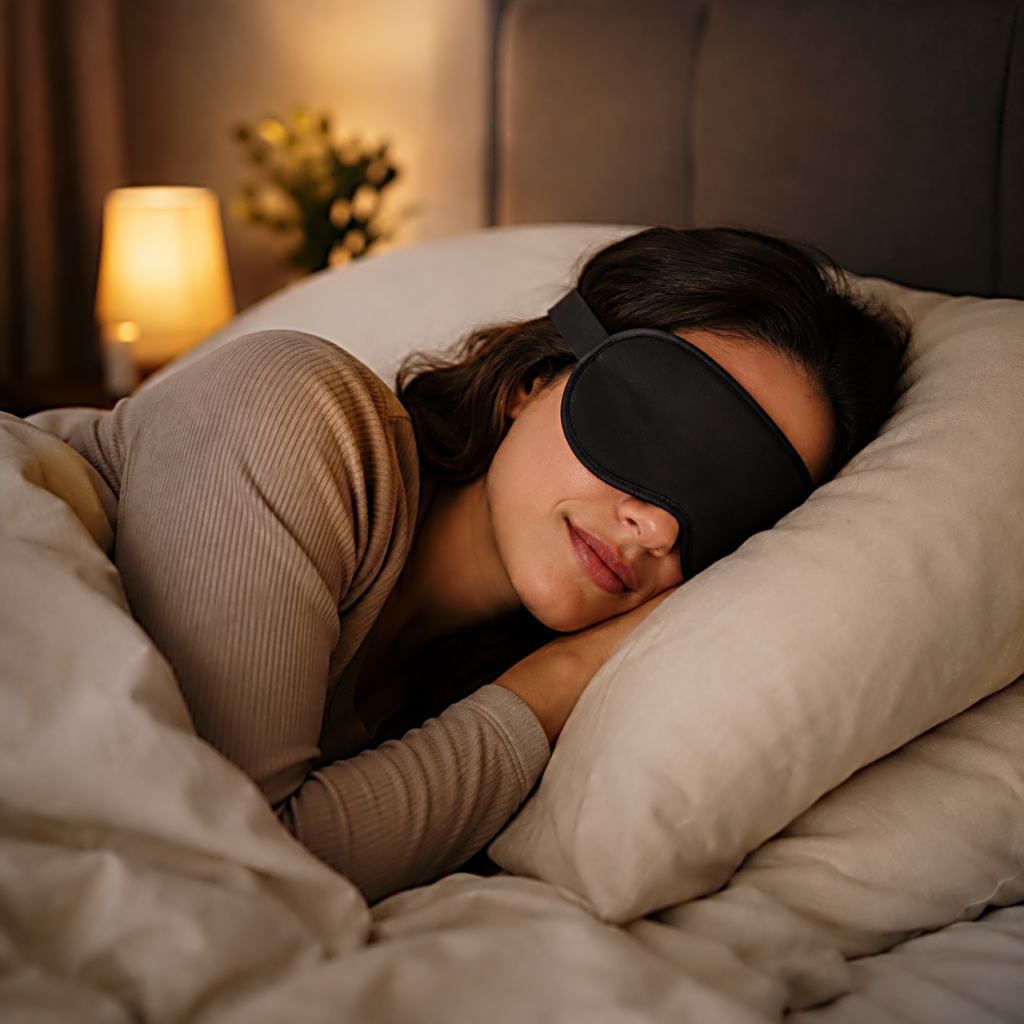
Twenty minutes in your sleep position tells you more than a product photo
Softness dominates the first impression. A new mask can feel comfortable because the fabric is fresh, the room has gone dark, and you have not worn it long enough for heat, pressure, or movement to become noticeable. The second impression is closer to the one that will matter at 3 a.m.
Give the fit enough time to change. Use the loosest strap setting that keeps the mask stable, then lie in the position where you usually fall asleep. The aim is not to prove that the mask can block light for a moment; it is to see whether it can remain dark without asking for repeated corrections.
- Dim the room and place the mask without pulling the strap tight.
- Check both sides of the nose for a narrow light gap.
- Blink, briefly open your eyes, and notice whether the interior touches your eyelids or lashes.
- Turn onto your usual side and find where the edge, buckle, and strap meet the pillow.
- Wear it for at least twenty minutes, then check for warmth, sliding, or pressure that was absent at the start.
This sequence separates adjustment from mismatch. A small strap change may stop ordinary movement, and repositioning a flexible nose piece may close a gap. If darkness requires strong tension or the pillow repeatedly pushes the mask out of place, the underlying shape is probably doing too little.
Hair and closure position can be judged during the same test. A hook-and-loop edge that catches hair, an elastic band that rolls upward, or a buckle that lands directly beneath the head will not become less relevant after a full night. The back of the mask deserves attention precisely because you should not have to think about it once the lights are off.
Travel adds one final variation without changing the order of the test. A flat mask packs smaller, while a molded design protects eye space but takes more room and may need a case to keep its shape. On a plane or train, replace the familiar pillow with a headrest and check which edge or closure will carry the pressure there.
The most compact option is not automatically the better travel mask if it needs constant readjustment. A slightly larger design can earn its space by fitting consistently, just as a thin mask can be the practical choice when it already follows your face well. Packability matters after the nose seal and temple comfort have survived the position in which you will actually use it.
The right mask becomes quiet before you fall asleep
Return to the first turn toward the pillow. The lower edge stays close beside the nose, the strap follows the head without pulling, and the temple meets fabric rather than a hard buckle. Eye space, silk, padding, or weight can still shape the experience, but none of them has been asked to correct a fit problem that began at the edge.
That leaves a shorter buying decision than most feature lists suggest. Start with the nose contour, test how the outer profile behaves on your pillow, and use only enough strap tension to keep the mask steady. Choose eye depth according to eyelid contact, then let material, care, weight, and packability settle the remaining differences.
The room does not become more dramatic when the fit is right. You put on the sleep mask, turn to the side you know, and wait for the small line of light that appeared before. This time it does not return, and neither does your hand to the strap.
Related FAQ
Price matters, but comfort and fit decide whether sleep mask will be used every day. A cheaper item that solves the real problem can be better than a premium product that does not fit the setup.
Test it in the actual routine it was bought for. A useful product should make work, focus, recording, or rest easier without needing constant adjustment.
Price matters, but comfort and fit decide whether best monitor light bar will be used every day. A cheaper item that solves the real problem can be better than a premium product that does not fit the setup.
Test it in the actual routine it was bought for. A useful product should make work, focus, recording, or rest easier without needing constant adjustment.
Test it in the actual routine it was bought for. A useful product should make work, focus, recording, or rest easier without needing constant adjustment.
Before You Go
Paid links- Advertisement -